HyperMarkDown
HyperMarkDown (.hmd) is ordinary Markdown plus rich visuals plus wiki links
into a knowledge graph. Every .md file is already valid .hmd.
Want to see it in action?
- Tools for HyperMarkDown: the Quick start is two
installs — the VS Code-compatible editor extension, then the
hmdcommand — and what each one gets you. - How to write HyperMarkDown: The HMD Tutorial is the whole language in one go — every construct, with its source shown beside what it renders.
TL;DR

-
A syntactic superset of CommonMark. Rename a
.mdfile to.hmdand it remains valid. HMD preserves CommonMark constructs while assigning added meaning to HMD syntax such as wikilinks and frontmatter. -
Names, not paths.
[[tokens]]is looked up beside the card and then upward through its parent folders. Multiple autodiscovery matches are an error; explicitly ordered import paths use declaration precedence. -
Documents made of documents.
![[glossary/token#^definition]]splices one named block into another page. Write a definition once and embed it everywhere it is needed. -
Rich content is assumed, not optional. TeX mathematics, D2 diagrams, callouts, footnotes, task lists, and tables are part of what a card may carry. A diagram is text in the file and a diff you can read, and it degrades to its own labelled source rather than to a blank space.
-
The specification is the artifact. The Python CLI, the MkDocs plugin, and the VS Code extension are implementations around it; they conform to it rather than define it.
-
What ships today is not the whole of it. The resolver, linter, embed expander, renderer, and MkDocs plugin are released and in use. Queries over the document graph and namespaces beyond one tree are specified in outline and unbuilt; where they are going is the Roadmap.
Language
Three layers stack in one file. At the base, CommonMark, inherited whole —
nothing redefined and nothing taken away, which is why a .md file is already
a valid card. Above it a rich layer — tables, footnotes, task lists,
callouts, TeX mathematics, D2 diagrams — taken from the wider Markdown
ecosystem rather than invented here, and assumed present rather than optional.
And the hyper layer — arguably the most innovative part, and the reason the
format exists at all: a small set of constructs that are all variations on one
idea, naming another document or a part of one. Those upper two layers are
what HyperMarkDown adds, and a specification is what fixes them, not
convention.
See [[tokens]] for the format, or pull one block in whole:

![[glossary/token#^definition]]
A card may open with YAML frontmatter, where four keys mean something to the
toolchain — tags, use, import, nav — and every other key belongs to the
author. The whole language fits on one page and can be learned in one sitting:
the HMD Tutorial. What that page teaches, the
HMD Language Specification states normatively.
Features
Wiki links to documents, headings, and named blocks; transclusion of any of them; filesystem-shaped modules with explicit imports; TeX mathematics, D2 diagrams, callouts, collapsible sections, footnotes, tables, and the GitHub- flavoured Markdown baseline. HQL, a query language over the document graph, is reserved, and the grammar is not fixed — what it is wanted for is the Roadmap.
What a page can carry, shown working rather than described, is Features. How a bare name becomes a page — the spine walk, imports, autodiscovery ambiguity, and the module/namespace distinction — is Namespaces.
Tools
hmd lints a tree, renders a card to markdown or HTML, and dumps the resolved
graph. A missing target is a warning, because writing forward is how a wiki
grows. Malformed references and multiple autodiscovery matches are errors;
ordered wildcard imports resolve by declaration order and report shadowing.
Installing rather than reading: the editor extension, the package, and what each one gets you is the Quick start.
There are three of them, one directory each under tools/ in the repository,
each carrying its own version, README, and changelog:
-
hmd— the Python implementation, published to PyPI ashypermarkdown: the CLI (lint,render,graph), the library beneath it, and the MkDocs plugin that builds this site. Canonical — where two implementations disagree, this one defines the answer — and it will host the language server. -
hmd-ts-core—@hypermarkdown/core, a second implementation of the format in TypeScript rather than extension code, answering to the same conformance corpus the canonical tool does. -
hmd-vsc-ext— the VS Code extension: live preview that keeps the embed boundary visible, plus a graph of the vault, red links, and diagnostics.
Those are the sources. Getting them running — the extension, then the package, and what each one is for — is the Quick start.
Presentation is not part of the language. A card is plain text, so an editor, GitHub, or a chat window already shows it. The MkDocs plugin builds a tree of cards into a published site — this one, a hand-ordered book with a generated wiki inside it — and the extension renders one in the editor as it is typed. The trade-offs between them are Presentation.
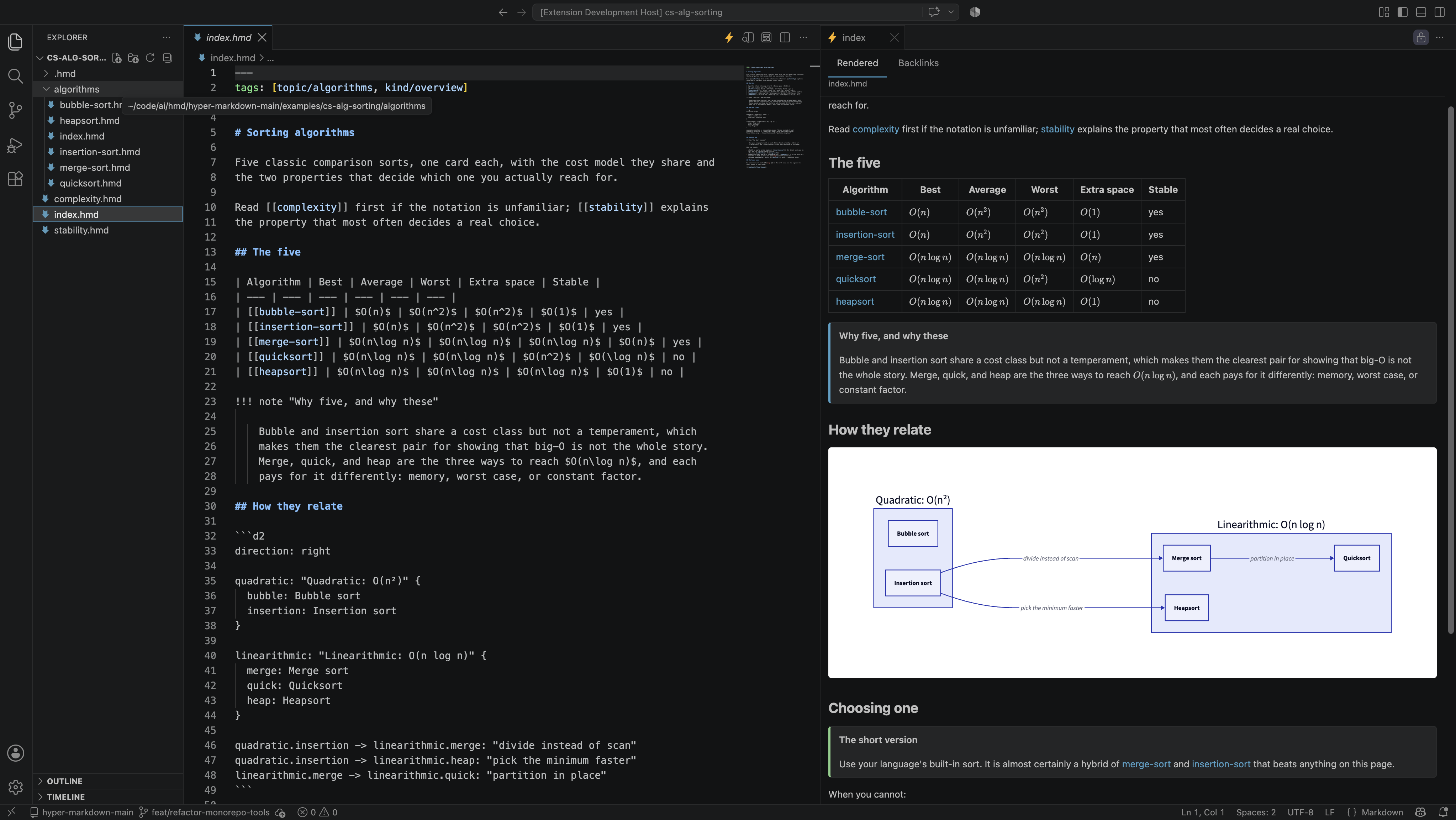
The VS Code extension: the card's source on the left, the rendered card on the right, updated as it is typed.
Specification
The normative text is one document, the HMD Language Specification: what a card is, what each construct means, and what an implementation must do with it. It describes no particular program, and no program's behaviour overrides it.
It is stated against a named baseline — CommonMark 0.31.2 — because "markdown"
names a family rather than a standard, and a superset of an unnamed dialect
specifies nothing. And it is versioned apart from the tools that implement it: a
release of hmd does not imply a new language version, and a language version
does not wait for one. Where two implementations disagree about something the
text leaves under-determined, the language-neutral conformance corpus decides.
The language is at 0.1. The text is drafted, and it will move before 1.0.
How it gets there is a separate formal process. A change
is argued out first as a numbered technical proposal — HMD-0001, HMD-0002,
and so on — in the style of RFCs and lightweight ADRs: a problem, the decision
taken, the alternatives rejected, and a tracker of its own. Most of them are not
about the language at all, and cover the tools and the presentation layer
instead: how a bare name is resolved on disk, what the linter reports, how a tree
of cards becomes a published site. They are working documents, kept for their
motivation and their rejected alternatives, and where one disagrees with the
specification the specification is right. The index is
Proposals.
Vision
Markdown became the default plain text, and never got the part HTML had on its first day — links that mean something because they point into a knowledge graph, and a page that is part of a web rather than a file in a folder. Almost none of the ideas here are new; what is being attempted is a coherent specification of them.
The longer argument is that this should not stop at one repository: independently authored and independently served HyperMarkDown, named across the gap, read from the same source by humans, tools, and AI. That argument, and how much of it is still unbuilt, is Vision.
Where this is going
The tools are released and installable, and the specification is at 0.1 and still moving. Which version of what is out, what the writing still owes the code, and the large features being aimed at next — semantic search over a collection of cards, and the query language underneath it — are the Roadmap.
The living example is the wiki, generated from .hmd cards in
this repository.